
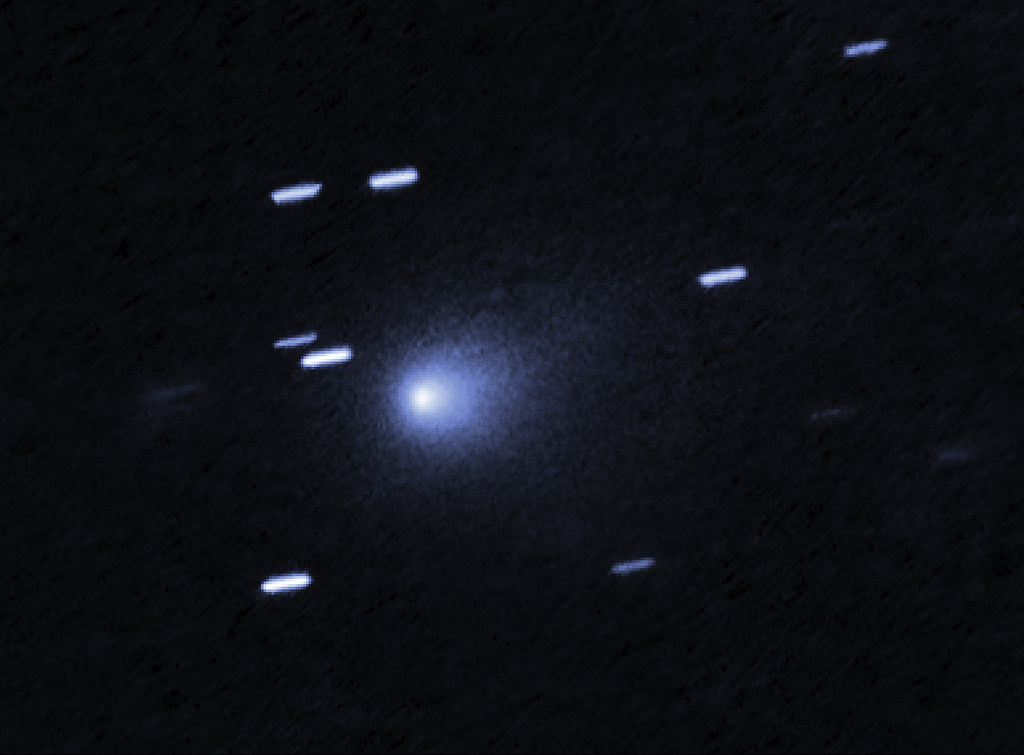
The interstellar comet 3I/ATLAS — the third such object ever recorded to enter our solar system from beyond — has been declared the formal target of an international planetary-defense exercise coordinated under global agencies.
Launched last July by the ATLAS survey telescope in Chile, 3I/ATLAS follows a hyperbolic trajectory that confirms its origin outside the solar system. Unlike the typical comets bound to the Sun, its orbit makes a one-time swing through our system before heading back into interstellar space.
Though scientists emphasize the comet poses no threat to Earth — its closest approach will still be hundreds of millions of miles away — it presents a unique opportunity for the astronomy community to test and refine the tools and methods used to track near-Earth and interstellar objects. The campaign aims to sharpen observation strategies, improve orbit predictions, and stress-test global readiness to respond to future cosmic encounters.
In addition to mapping its path, astronomers are analyzing its behavior: the comet has shown a glowing coma (a halo of gas and dust) and a long tail, both typical of active comets but monitored closely given the object’s unusual origin. Instruments including the Hubble Space Telescope and ground-based observatories are delivering images and spectral data to help characterize its composition and motion.
The 3I/ATLAS campaign — now part of the standard observation exercises carried out under the International Asteroid Warning Network (IAWN) framework — signals a growing acceptance that interstellar visitors, while rare, may offer valuable tests of planetary-defense systems. The ongoing work around 3I/ATLAS could help prepare Earth for future situations where a fast-moving object from outside our solar system demands rapid tracking and assessment.