
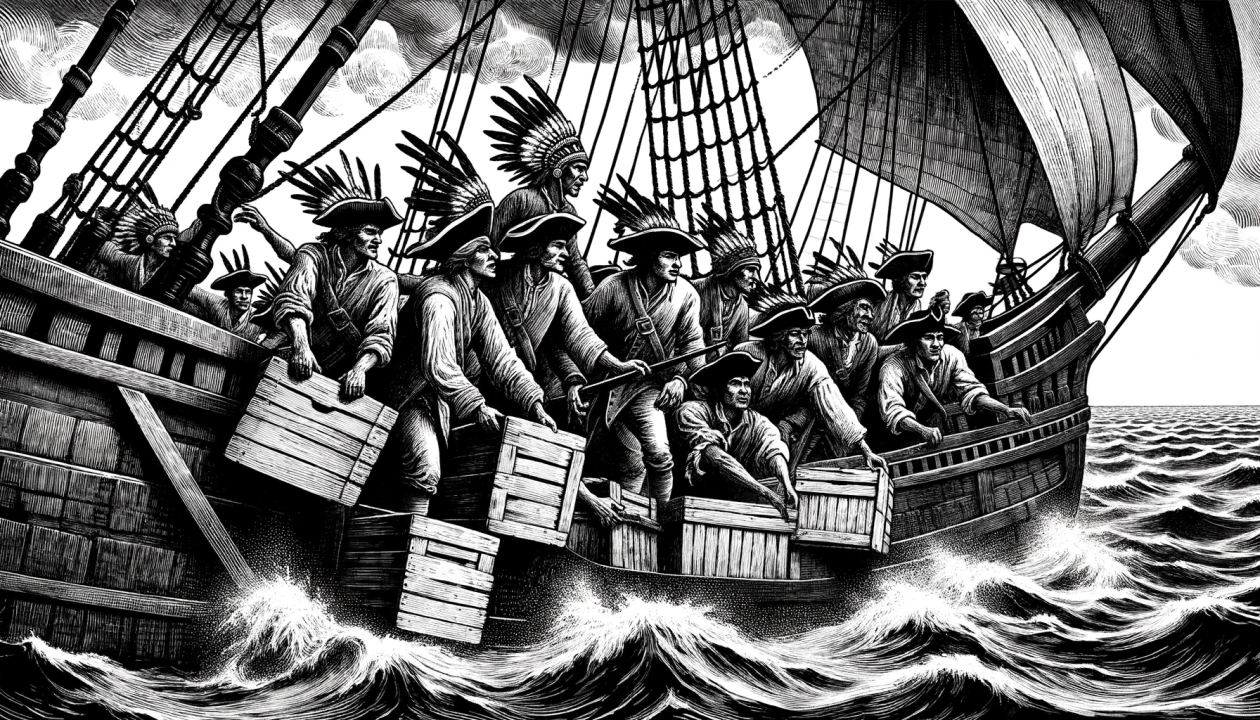
A thought-provoking piece in the Washington Post has stirred dialogue on the characterization of the Boston Tea Party, questioning the traditional glorification of the event as a hallmark of American revolutionary zeal. Columnist Theodore Johnson delves into the nuanced historical perspective of this pivotal act of defiance against the British Tea Act of 1773.
The article reflects on the revered narrative of the Boston Tea Party as a foundational legend that embodies the American spirit of revolution and democracy, immortalizing the phrase “no taxation without representation.” Yet, Johnson introduces an alternative narrative that has been largely overlooked in mainstream historical discourse. He suggests that the actions of the colonists, who disguised themselves as Native Americans, could be seen through a contemporary lens as not only criminal but akin to an act of terrorism due to the destruction of private property and the law they opposed.
Johnson draws on the work of historian Benjamin Carp, author of “Defiance of the Patriots: The Boston Tea Party & the Making of America,” to support the view that while the event was driven by principles and nonviolent actions of common citizens, it still constituted criminal activity. The column, aptly titled “Was the Boston Tea Party an act of terrorism? It depends,” challenges readers to reconsider the complexity of historical events.
The discussion extends beyond the actions in Boston Harbor to the broader implications on America’s national identity and the myths that shape it. Johnson notes that these myths, blending fact and fiction, influence societal behaviors and perceptions of virtue. He argues that the predominant historical narratives often fail to resonate with the diverse demographic fabric of contemporary America, which includes many who are descendants of individuals historically labeled as threats or marginalized.
The column calls into question when a more inclusive national mythos will emerge, one where the heroes reflect the rich diversity of the American populace. Johnson posits that figures like Harriet Tubman, Rosa Parks, and Thurgood Marshall exemplify true adherence to American principles, demonstrating that inclusion is the highest expression of national virtue rather than a threat to it. This introspection invites a re-evaluation of how historical events are interpreted and their impact on national identity.