
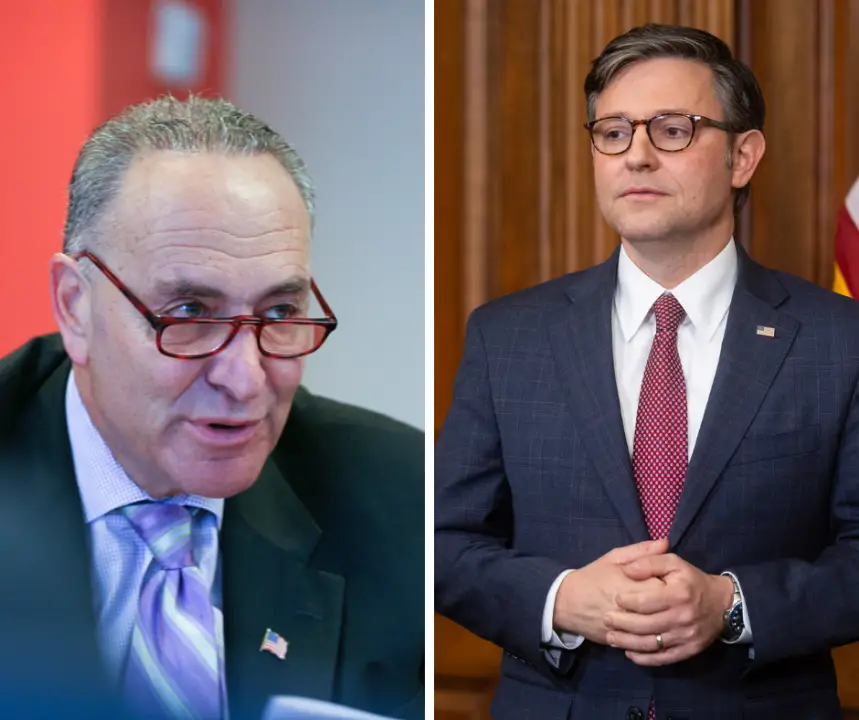
In a recent development within the U.S. House of Representatives, a rift has emerged among conservative lawmakers over a bipartisan agreement designed to avert a government shutdown. The pact, orchestrated by House Speaker Mike Johnson, a Republican from Louisiana, and Senate Majority Leader Chuck Schumer, a Democrat from New York, is facing stiff opposition from the House Freedom Caucus.
The Freedom Caucus, known for its stringent conservative principles, has raised objections to the spending levels outlined in the deal. They contend that the agreement proposes a programmatic spending level of $1.658 trillion, overshooting the previously agreed-upon cap of $1.59 trillion, a figure they find excessive.
This conflict has led to a critical impasse in Congress, as legislators race against time to prevent a government shutdown. The urgency is heightened by the imminent expiration of federal funding for certain agencies on January 19, followed by a broader deadline on February 2. Complicating matters, the House has been functioning with a narrow two-seat majority for most of January due to Majority Leader Steve Scalise’s absence for cancer treatment.
To circumvent procedural hurdles, House leadership might have to introduce spending bills under suspension, requiring a two-thirds majority for passage, rather than a simple majority. This scenario necessitates the support of Democrats for any appropriations bills to clear the House.
Republican Representatives Marjorie Taylor Greene of Georgia and Tim Burchett of Tennessee have openly opposed the agreement. Greene criticized the deal for neglecting crucial issues such as border security and fiscal responsibility, while Burchett indicated his expectation of substantial budget cuts as a precondition for his support.
The agreement, as put forth by Johnson and Schumer, aims to fund the government at a statutory topline of $1.59 trillion for the remainder of fiscal year 2024, aligning with prior negotiations between Schumer and former Speaker Kevin McCarthy. The plan includes the majority of a $69 billion side deal between McCarthy and President Biden, with Johnson claiming to have secured an additional $16 billion in spending reductions to counterbalance this.
However, the agreement has not been universally welcomed within Republican circles. Texas Representative Chip Roy labeled the spending level as “terrible” and a compromise on previously gained leverage. In contrast, a GOP aide argued that the deal represents a victory for Republicans, citing more extensive cuts than those in the Fiscal Responsibility Act deal.
As Congress resumes following the holiday break, the outcome of the government funding deal remains uncertain, with the specter of a government shutdown looming if a consensus is not reached.