
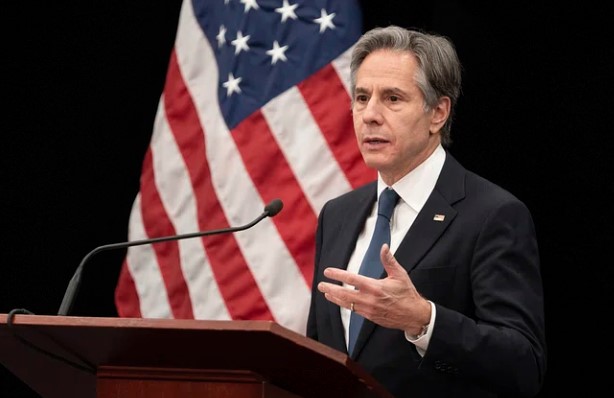
In a candid statement, Secretary of State Antony Blinken conceded on Monday that his efforts to reestablish military-to-military communications between the United States and China had fallen short during his much-anticipated visit to Beijing, orchestrated by the administration.
“I firmly believe that maintaining military-to-military communication is of utmost importance,” Blinken emphasized during a press conference, highlighting recent encounters between the U.S. and Chinese military, including an incident in late May where a Chinese fighter jet aggressively approached a U.S. military aircraft in the South China Sea.
“Unfortunately, at present, China has not expressed willingness to move forward in this regard. It’s a matter we must persistently address. Restoring those channels is of paramount significance,” he added.
Complicating matters further was an unsettling incident earlier this year when a Chinese spy balloon infiltrated U.S. airspace, evoking a vehement response from both Republicans and Democrats. Consequently, Blinken’s planned trip to Beijing during that period had to be postponed.
The Biden administration immediately attempted to reschedule the meeting but encountered obstacles until now.
Beijing has effectively halted high-level military communications with the Pentagon and recently declined Defense Secretary Lloyd Austin’s proposal to engage with his Chinese counterpart at an Asian security conference in Singapore.
Hence, one of the primary objectives of the Biden administration’s visit to China was to revive military-to-military communications with China, particularly in light of China’s increasing belligerence towards Taiwan and the U.S. military’s efforts to ensure free passage in the region, as well as deter further Chinese aggression against Taiwan.
Blinken reiterated the administration’s commitment to restoring military-to-military relations with China, stating:
“If we agree that it is our shared responsibility to prudently manage this relationship, and if we acknowledge that preventing competitive elements from escalating into conflict serves both our interests, then surely we can understand the necessity of establishing and maintaining channels of communication, including those between our respective militaries.”
“So, this is an ongoing endeavor for us. While immediate progress may be lacking, it remains a top priority,” he added.
Addressing the matter at a press conference on Friday, Defense Secretary Austin expressed his determination to establish communication with his Chinese counterpart. Responding to a question, he asserted, “I am confident that, in due course, we will achieve that. We will meet at some point, and we have made attempts to do so, which we will continue.”
“The door is open, my line is open, and they can reach out to us at any time. We will persist in ensuring open lines of communication,” he affirmed.
“It is vital for countries with significant military capabilities to have the means to engage in dialogue, enabling us to effectively manage potential crises and ensure that situations do not needlessly spiral out of control,” he added.
“Our aspiration is to foster a relationship of healthy competition, not one characterized by contention. Therefore, we will persist in our efforts to open lines of communication whenever and wherever possible.”