
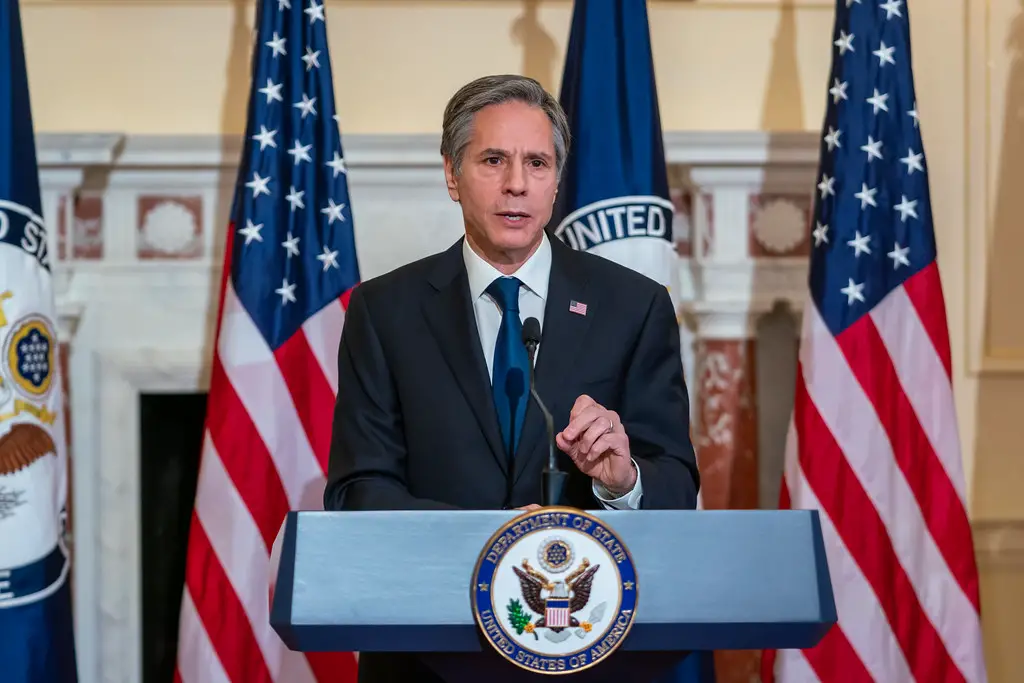
Secretary of State Antony Blinken made it clear that the United States does not support Taiwan’s independence following his meeting with Chinese President Xi Jinping on Monday.
During his visit to Beijing to mend strained relations between the U.S. and China, Blinken emphasized the U.S. stance on Taiwan during a press conference held after his meeting with President Xi. He stated, “We do not support Taiwan independence” and reaffirmed the opposition to any unilateral changes to the status quo by either side.
The Secretary of State had a 35-minute discussion with President Xi at the Great Hall of the People, situated on the western side of Tiananmen Square. Blinken emphasized that the long-standing U.S. One China policy remained unchanged.
China maintains the belief that Taiwan is an integral part of its territory and has not ruled out the possibility of annexing Taiwan forcefully.
While the U.S. maintains informal diplomatic relations with Taiwan, Blinken also reiterated the U.S. commitment to its responsibility under the Taiwan Relations Act, which includes ensuring Taiwan’s ability to defend itself.
During the meeting, Blinken raised concerns about China’s provocative actions in the waters surrounding Taiwan. He expressed the widespread concerns shared by numerous countries, including the United States, regarding the potential economic ramifications of a crisis over Taiwan. Given the significant commercial container traffic and semiconductor production in Taiwan, Blinken highlighted the potential global impact such a crisis could have.
Blinken concluded by emphasizing the U.S.’s expectation for a peaceful resolution of differences across the Taiwan Strait.
President Xi responded positively, remarking, “This is very good,” indicating satisfaction with the progress made during the meeting. However, he also hinted at China’s grievances and stressed the importance of mutual respect and sincerity in state-to-state interactions.
While the meeting addressed important issues, Blinken acknowledged that one of the primary goals, establishing a crisis military-to-military communication channel, was not achieved.
U.S.-China relations have deteriorated in recent years due to various factors, including the Taiwan issue, China’s close ties with Russia, concerns over a suspected Chinese spy balloon over the U.S., and data security issues related to the app TikTok.
Recent incidents involving close encounters between U.S. and Chinese military ships and aircraft have further strained the relationship. The U.S. military released footage earlier this month showing an “unsafe” maneuver by a Chinese navy ship that crossed the path of an American destroyer, prompting the latter to reduce speed to avoid a collision. In May, a Chinese fighter pilot executed an “unnecessarily aggressive maneuver” while intercepting a U.S. aircraft in the South China Sea, as stated by the U.S. Indo-Pacific Command.
In 2022, the trade between the U.S. and China reached a record $690 billion, highlighting the economic significance of the relationship between the two countries.