
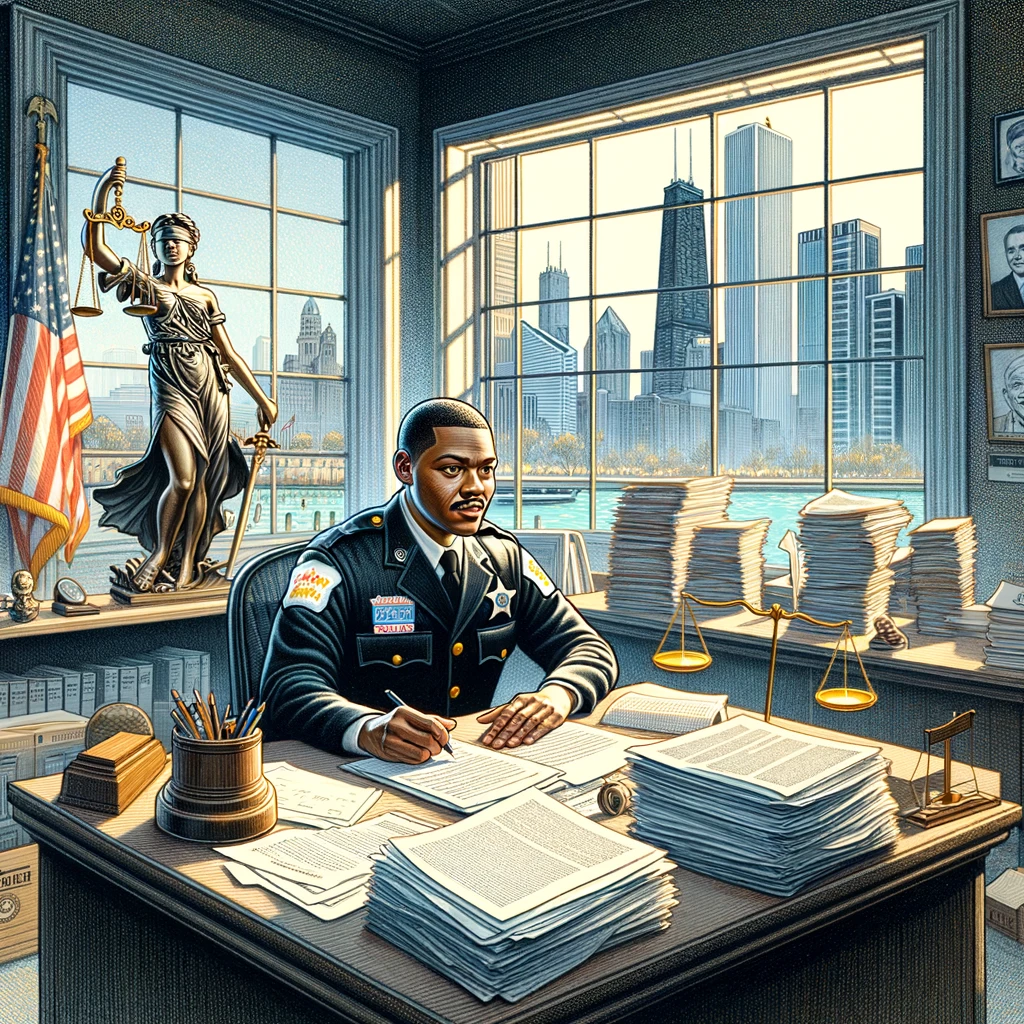
In a unique legal battle emerging from Chicago, a police officer, Mohammad Yusuf, aged 43, has initiated a federal civil rights lawsuit against the city, challenging its refusal to permit him to change his racial designation on official records. This lawsuit comes in the wake of the Chicago Police Department’s policy allowing officers to amend their gender identity on departmental records to reflect their lived experiences. Yusuf, contesting the department’s stance, asserts his right to identify as Egyptian and African American, diverging from his current classification as “Caucasian.”
Yusuf’s legal action underscores a broader debate on identity and the implications of such classifications on professional advancement within the Chicago Police Department. He alleges that the department’s refusal to acknowledge his racial identity has materially impacted his career, particularly in terms of promotions, which he claims are preferentially awarded to minority candidates under the department’s promotion system. Despite scoring highly on the sergeant’s exam in 2019, Yusuf contends that he has been consistently overlooked for advancement in favor of less qualified candidates, a situation he attributes to his racial designation.
At the core of Yusuf’s complaint is the department’s historical limitation on race selections for officers, a policy that, until recently, restricted choices to Caucasian, Black, and Hispanic. Although the department has expanded its racial categories to over nine distinct designations, it reportedly maintains a prohibition against altering an officer’s racial identity once recorded. Yusuf’s attempts to rectify his racial designation, including submitting DNA evidence from a “23 and Me” genetic test, were met with refusal, with the department allegedly requiring a DNA test as a precondition for such a change before ultimately deeming it unfeasible.
The lawsuit raises significant questions about race, identity, and discrimination within the context of employment and civil rights, invoking Title V of the Civil Rights Act of 1964 in its challenge against the city of Chicago. As this case unfolds, it promises to further the discourse on how institutions recognize and respect individual identity, particularly in professions with historically rigid structures like law enforcement.