
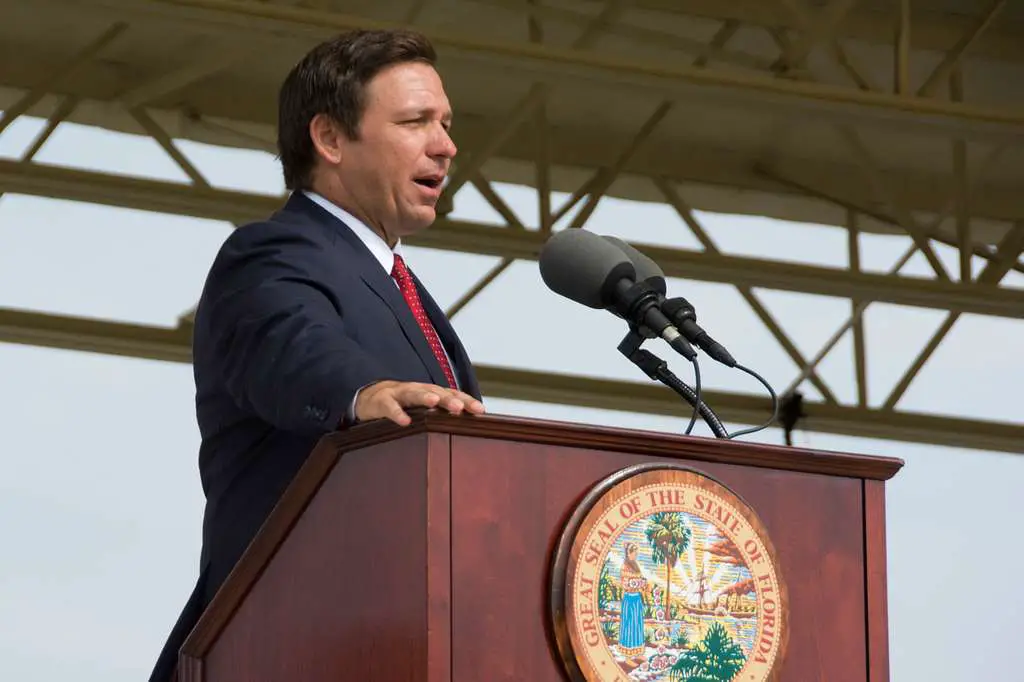
In a surprising turn of events, Florida Governor Ron DeSantis and Attorney General Ashley Moody have embarked on a legal battle against the Biden administration, accusing it of encroaching upon the constitutional rights of Florida’s education system. In a press conference held on Thursday, the governor made a resolute announcement about their decision to file a lawsuit targeting the Department of Education, Secretary Cardona, and other implicated parties. DeSantis underscored the numerous reforms Florida has implemented, including legislative changes, to enhance higher education.
During the press briefing, DeSantis raised concerns regarding accrediting agencies and their disproportionate influence over federal funding. He emphasized the need to explore diverse accreditors to ensure fair and appropriate accreditation standards. The governor elucidated the critical role of these agencies in determining the distribution of federal aid, highlighting the lack of transparency and accountability in their decision-making processes. DeSantis further expressed the state’s commitment to accountability by introducing mandatory performance reviews every five years for tenured professors, with the possibility of dismissal due to poor performance.
The governor also emphasized Florida’s dedication to fostering individuality, merit, and achievement through its Diversity, Equity, and Inclusion (DEI) initiatives. However, DeSantis acknowledged that certain higher education reforms introduced by Florida have not been well received by accreditation agencies, who assert that they know what is best for the people of Florida.
DeSantis shed light on the Biden administration’s attempt to suppress Florida’s endeavors by potentially withholding student aid as a consequence of these reforms. He explained that accrediting agencies, approved by the Department of Education, possess an unprecedented power to veto Florida’s legislative decisions. The governor vehemently rejected this notion, asserting that it contradicts the principles enshrined in both state and federal constitutions. He emphasized the absence of any provision granting unaccountable, unelected accrediting agencies the authority to override the state’s actions, especially considering that these reforms were initiated prior to the election and formed a significant part of their platform.
Consequently, DeSantis declared the arrangement unconstitutional on multiple grounds. Firstly, he argued that delegating legislative power to an unaccountable private entity without adequate checks and balances violates the private non-delegation doctrine. With over $100 billion in annual student aid contingent on accrediting agencies’ decisions, the governor expressed confidence in their stance. Secondly, he maintained that the arrangement contravenes the appointments clause of the Constitution. According to DeSantis, those exercising government power should be subject to Senate confirmation, as is the norm for executive appointees.
In the pursuit of accountability and the preservation of constitutional principles, Governor DeSantis and Attorney General Moody stand firm in their conviction that the current arrangement must be challenged through legal means. The outcome of this legal battle could have far-reaching implications for the state of Florida and the power dynamics between federal oversight and state autonomy in education.