
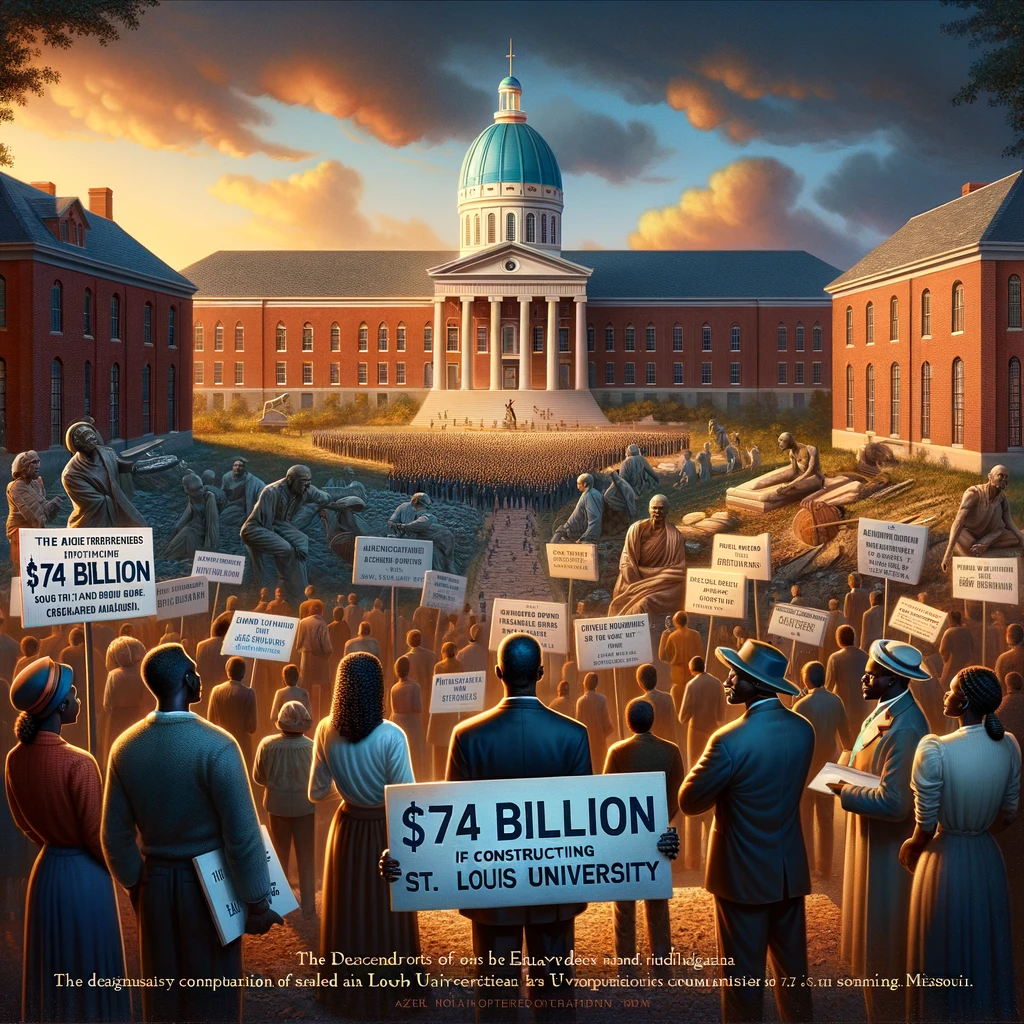
In a bold move for justice, the descendants of enslaved individuals who contributed to the construction of St. Louis University (SLU) in Missouri have made a claim for compensation, estimating the value of unpaid labor to be up to $74 billion. This demand was formally announced at the university itself, spotlighting an initiative led by the Descendants of St. Louis University Enslaved (DSLUE), alongside support from a state lawmaker, a civil rights attorney, and economists.
The calculation hinges on the labor of 70 enslaved people working nonstop from 1823 to 1865, with economist Julianne Malveaux placing the initial unpaid labor value at $365 million. When adjusted for interest over the years, this figure balloons to $70 billion. The group’s efforts aim to hold SLU accountable for its historical reliance on slave labor for its establishment and development.
Areva Martin, a prominent civil rights attorney representing DSLUE, has directly addressed SLU President Fred Pestello, urging the institution to take further steps towards reconciliation and compensation for its past actions. Despite SLU’s efforts to acknowledge and explore its historical ties to slavery through the Slavery, History, Memory, and Reconciliation Project (SHMRP), Martin and DSLUE argue that mere acknowledgment is insufficient for making amends.
DSLUE, founded by Robin Proudie after discovering her great-grandmother Henrietta Mills was born into slavery at SLU in 1844, seeks not only recognition but also reparative justice. The organization emphasizes that their request is not for charity but for the settlement of a longstanding debt owed to their ancestors, whose labor contributed significantly to the university’s early development.
SLU has responded to the claims with a statement expressing an understanding of the urgency conveyed by the descendants and acknowledging the institution’s participation in slavery as a grave sin. The university commits to continuing efforts towards reconciliation and building deeper relationships with descendant families to honor the memory of those enslaved by the Jesuits.
This case adds a significant chapter to the ongoing national conversation about reparations and the responsibility of institutions to address and remedy their historical injustices. The descendants’ claim against SLU underscores the broader implications of America’s slaveholding past and the pursuit of justice for those whose labor was exploited without compensation.