
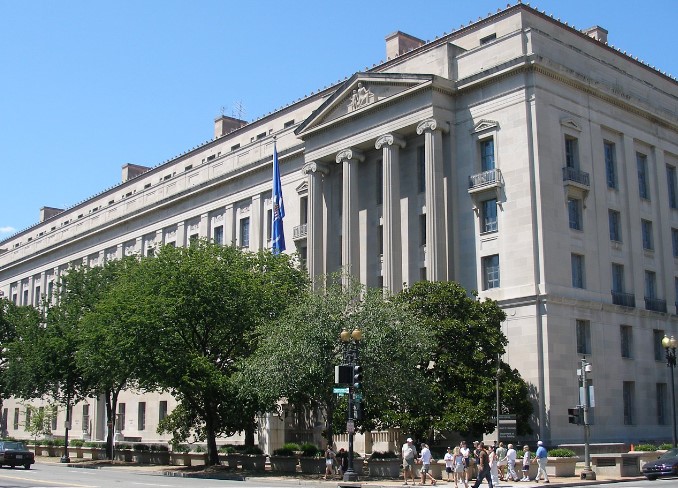
In an unprecedented legal development that reverberated across courtrooms, the Justice Department unveiled a groundbreaking argument this week, challenging the constitutionality of a recently enacted Florida law that sent shockwaves through the nation. This controversial law, which imposes restrictions on Chinese ownership near U.S. military installations and critical infrastructure, has come under intense scrutiny. In a bold move, the Justice Department filed a remarkable legal document, asserting that the law violates the fundamental principles enshrined in the 14th Amendment’s Equal Protection Clause and the Fair Housing Act of 1968 (FHA).
Crafting an impassioned declaration of significance, the Justice Department boldly contends that the Florida law inflicts severe harm on individuals solely based on their national origin, brazenly trampling upon their constitutional rights and disregarding federal civil rights laws. With resolute conviction, the DOJ argues that the state’s purported objective of bolstering public safety will not be achieved through these controversial provisions.
The Florida law imposes stringent restrictions on individuals and entities from designated “foreign countries of concern,” including China, Russia, Iran, North Korea, Cuba, Venezuela, and Syria. It unequivocally prohibits “foreign principals” – those domiciled in the People’s Republic of China without U.S. citizenship or permanent residency – from engaging in the acquisition of agricultural land or real estate within a ten-mile radius of military installations or critical infrastructure facilities in Florida.
While the law carves out limited exceptions for individuals holding non-tourist visas or those granted asylum, it boldly prohibits any form of real property acquisition by the People’s Republic of China, extending this prohibition to encompass Chinese political entities and corporate organizations.
Governor Ron DeSantis, an influential figure at the center of this legal storm, championed the law as a necessary and resolute response to the perceived influence of the Chinese Communist Party within the state. The Governor fervently argued that this legislative measure is essential to safeguard Florida’s interests, preserving economic freedom and thwarting potential threats posed by foreign powers. Aligning with DeSantis’s stance, Florida’s Commissioner of Agriculture, Wilton Simpson, underscored the paramount importance of securing food supplies, protecting national security, and preventing hostile foreign nations from exerting control over critical agricultural lands.
Opponents of the law, including the American Civil Liberties Union (ACLU), decry its provisions as a heavy-handed measure that places undue burden and engenders suspicion towards individuals with names remotely associated with Asian, Russian, Iranian, Cuban, Venezuelan, or Syrian origins. In a resolute effort to challenge the law’s provisions, the ACLU is providing legal representation to four Chinese citizens residing in Florida, as well as a prominent brokerage firm, both of whom are contesting the constitutionality of the law.
In a strategic legal maneuver aimed at bolstering the plaintiffs’ case, Yifan Shen, Zhiming Xu, Xinxi Wang, Yongxin Liu, and Multi-Choice Realty, LLC filed a complaint seeking a preliminary injunction. The Justice Department, seizing upon this opportunity, filed a persuasive document to lend support to the plaintiffs’ cause. U.S. District Judge Allen C. Winsor has slated a crucial hearing in mid-July, eagerly anticipated as it promises to be a pivotal moment in this high-stakes legal battle.
Governor Ron DeSantis is not alone among Republican presidential contenders who harbor concerns regarding the Biden administration’s perceived inaction on addressing the national security risks associated with Chinese influence within U.S. institutions. Drawing attention to the acquisition of vast land holdings, amounting to nearly 400,000 acres, including farmland adjacent to sensitive military facilities, former U.N. Ambassador Nikki Haley delivered a resounding foreign policy address in Washington, D.C. Haley vehemently stressed the pressing need to address this issue, emphasizing the fine line that separates Chinese investors from the Chinese Communist Party. She fervently warned about the potential threats posed to national security, food supplies, academic freedom, and freedom of speech, all of which demand immediate attention and decisive action.