
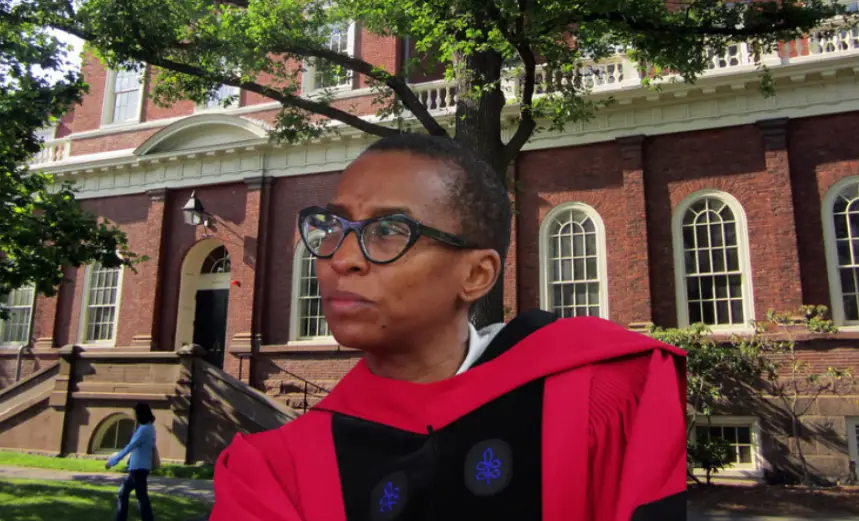
Harvard University President Claudine Gay, currently embroiled in a series of academic disputes, faces renewed scrutiny over her past scholarly work. Gay, during her tenure as a student at Stanford University, authored a significant paper in 2001 titled “The Impact of Black Congressional Representation on Political Participation.” This paper, critical in Gay’s academic journey, particularly in her pursuit of tenure at Stanford, has come under examination for its research methods and Gay’s reluctance to share her data for peer review.
In 2002, two scholars, Michael C. Herron of Dartmouth and Kenneth W. Shotts of Stanford, presented their findings at the Society for Political Methodology (PolMeth) conference, revealing discrepancies in Gay’s research. Gay’s paper posited that the election of African American legislators had a negligible effect on increasing political participation among African Americans and might negatively impact the political involvement of Caucasian individuals.
Herron and Shotts pointed out the issues in Gay’s paper, attributing them to her use of ecological regression (El-R), a statistical method they demonstrated could produce inconsistent results. Their analysis was, however, limited due to Gay’s refusal to release her research data.
Between 2000 and 2004, Herron and Shotts published several articles critiquing the use of El-R and its implications. Still, their inability to access Gay’s dataset impeded a full assessment of her conclusions. As stated in their 2002 publication, “We were unable to examine Gay’s results because she refused to disclose her dataset.”
Gay’s reluctance to share her research data has raised questions about the validity of her findings. This issue has been compounded by recent plagiarism allegations. Gay addressed an issue in a 1990 paper involving improper citation and source attribution in her revised 2001 publication. These concerns have prompted a more comprehensive review of her research practices and academic integrity.
Amidst these controversies, Harvard faculty members are increasing pressure on the university’s governance board, advocating for action to be taken. Critics argue that the allegations against Gay have tarnished Harvard’s esteemed reputation. The university has not yet publicly responded to requests for comment on these recent developments and allegations against President Gay.