
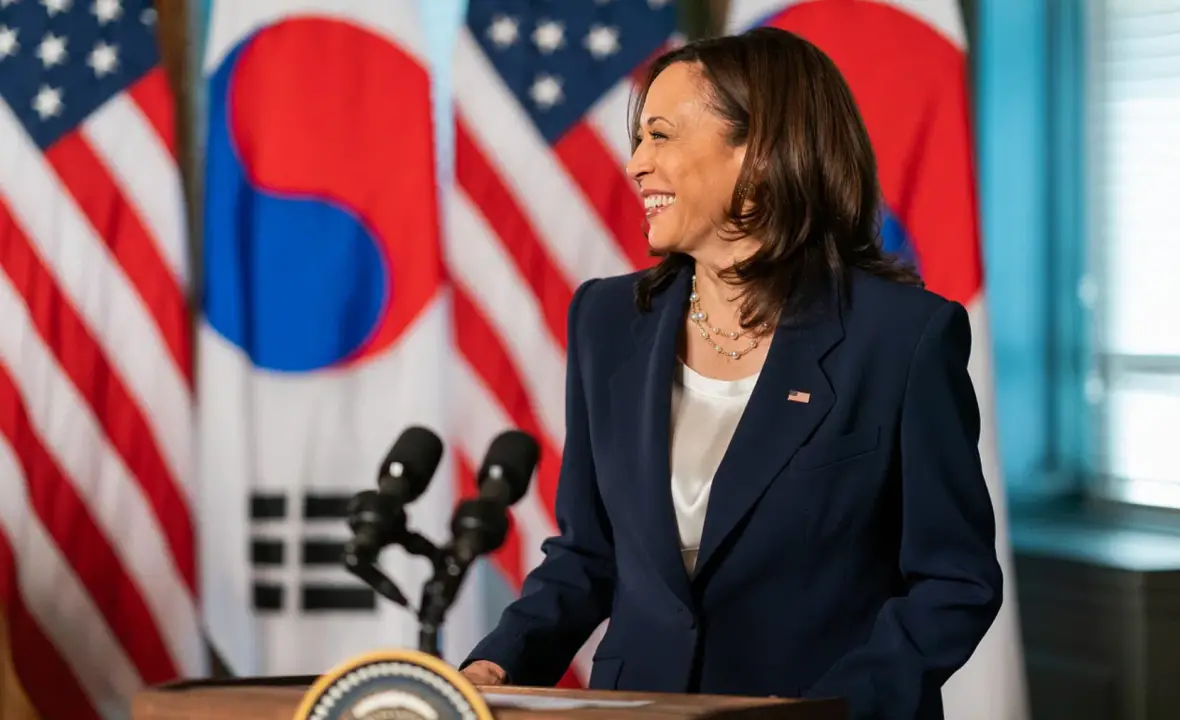
Vice President Kamala Harris Stresses the Need for Stricter Gun Control
In the wake of a devastating shooting incident that resulted in the tragic loss of at least 18 lives and left numerous others wounded in Lewiston, Maine, Vice President Kamala Harris addressed the pressing issue of gun violence. During her speech at a State Department luncheon, where she was joined by Australian Prime Minister Anthony Albanese, Harris commended Australia’s strict gun control laws and emphasized their potential to reduce the frequency of mass shootings.
Harris began her speech by acknowledging the dire impact of gun violence in the United States, stating, “As we gather information, it is crucial that we address the reality of the situation we are currently facing.” She pointed out that firearms now stand as the leading cause of death among American children, casting a long and dark shadow of fear and suffering over numerous communities.
The Vice President went on to draw attention to Australia’s distinctive approach to gun control, asserting, “Let there be no doubt, it doesn’t have to continue in this manner — as our Australian friends have convincingly demonstrated.” Her words received a positive response from the audience.
Australia’s stance on gun ownership significantly contrasts with that of the United States, as explicitly detailed on the official website of the Australian Parliament. Unlike the United States, Australia does not grant its citizens a constitutionally protected right to own firearms, and self-defense is not considered a valid reason under Australia’s stringent gun laws. Australians are required to provide alternative justifications for firearm ownership.
Furthermore, Australian law dictates that individuals seeking to purchase firearms must possess a valid firearms license, and each firearm they acquire must undergo individual registration. This stringent requirement stands in sharp contrast to countries like New Zealand and Canada, where firearm purchasers need permits but have greater leeway once licensed.
Australia’s strict gun control laws were instituted in response to a series of highly publicized mass shootings in 1996. The resulting National Firearms Agreement of 1996 banned fully automatic and semi-automatic firearms, introduced comprehensive firearm registration, imposed strict storage requirements for all firearms, and significantly limited access to military-style semi-automatic rifles and shotguns. The Australian government also initiated a mandatory gun buyback program, leading to the surrender of nearly 700,000 privately owned firearms.
Former Australian Prime Minister John Howard reflected on the success of these measures in a 2013 opinion piece for The New York Times, noting, “Ultimately, we succeeded in changing gun laws because there was majority support across Australia for the prohibition of certain weapons.” The reforms of 1996 are now widely acknowledged for reducing both the gun-related homicide and suicide rates.
The suspected perpetrator of the Lewiston, Maine, shooting is Robert Card, a former firearms instructor and Army Reserve petroleum supply specialist with a history of mental health concerns. A large-scale manhunt for Card is underway, involving over 350 officers from various federal, state, and local agencies.
As the nation grapples with finding a solution to the urgent problem of gun violence, the White House has yet to issue a statement. Vice President Harris has emerged as a prominent advocate for stricter gun control measures, shaping the national dialogue on this critical issue.