
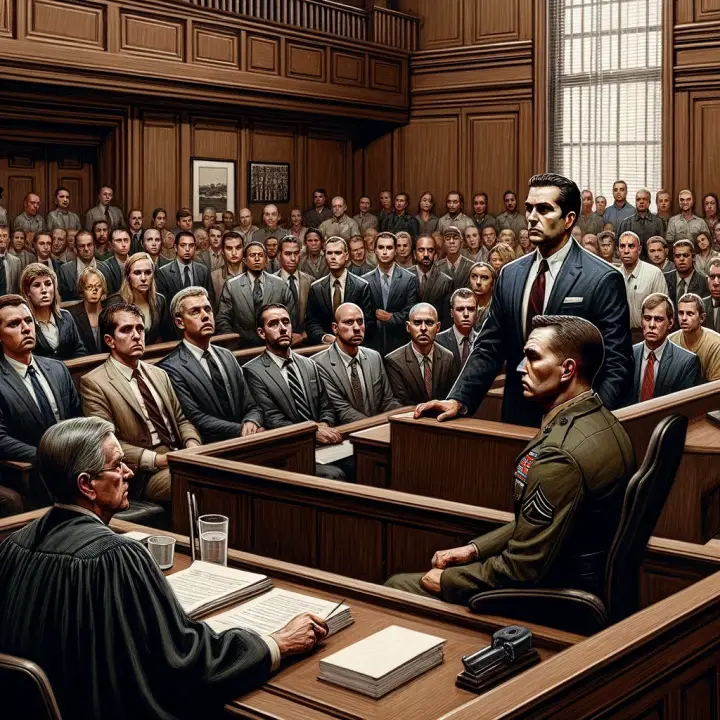
In a significant development in a New York City courtroom, a judge has ruled against dismissing the criminal charges against Marine veteran Daniel Penny. Penny, who faced charges related to the death of Jordan Neely following a chokehold incident on a subway in May of last year, had his request for dismissal denied, keeping the case active.
Daniel Penny, represented by attorney Thomas Kenniff, had argued for the dismissal of the indictment, asserting that Penny acted in self-defense and to protect fellow subway riders from Neely, who was exhibiting erratic behavior. Despite this, Judge Maxwell Wiley decided not to grant the dismissal, a decision that Penny’s attorney acknowledged as part of the legal process, expressing confidence in a fair jury verdict.
The incident, which gained widespread attention, occurred when Penny, alongside two other passengers, restrained Neely, a homeless individual known for his Michael Jackson impersonations, after Neely reportedly caused a disturbance on the subway. The altercation resulted in Neely losing consciousness and later dying.
Donte Mills, representing Neely’s family, called the judge’s decision a significant victory. He noted that in addition to the dismissal request, Penny’s legal team had sought to suppress statements made by Penny to law enforcement, invalidate search warrants, and suppress evidence obtained. These additional motions are still pending.
The case has sparked heated public debate, with some viewing Penny as a hero for his actions, while others have condemned him, leading to protests and rallies. The incident, captured on video, showed Penny, who is White, holding Neely, who was Black, in a chokehold, igniting discussions around race and justice.
Penny, a former infantry squad leader and water survival instructor who served two deployments between 2017 and 2021, turned himself in 11 days after the incident. He has been charged with second-degree manslaughter and criminally negligent homicide, pleading not guilty to the charges.
The complexity of the case is heightened by Neely’s background, including a history of mental illness and multiple arrests for violent assaults. This has led to a nuanced public discourse about the responsibilities of individuals in volatile situations and the broader implications for societal treatment of mental health and homelessness.
With the case set to proceed, all eyes will be on the forthcoming legal developments, as they will undoubtedly contribute to the ongoing conversation about justice, responsibility, and community safety in urban environments.