
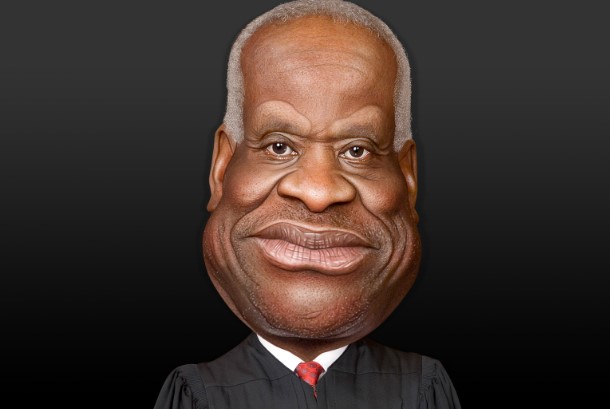
In a groundbreaking Supreme Court decision on Thursday that limited the use of race considerations in college admissions, Justice Clarence Thomas dismantled the “race-infused worldview” held by his colleague, Justice Ketanji Brown Jackson, in a uniquely powerful manner.
As the second African American justice to serve on the bench, Thomas supported the majority verdict of 6-3 and proclaimed that the court’s decision exposed universities’ admissions policies as aimless, race-based preferences intended to engineer a specific racial mix among their incoming classes.
Thomas highlighted the failure of Justice Jackson’s racially influenced perspective at every step. He emphasized that an individual’s unique experiences, challenges, and triumphs define them as a person, and race should not be attributed blame for anything positive or negative that occurs in their lives.
In his concurring opinion, Thomas offered an originalist defense of the colorblind Constitution, asserting that all forms of race-based discrimination, including affirmative action, are prohibited by the Constitution. He underscored the detrimental effects of such discrimination.
Thomas derided Justice Jackson’s dissenting opinion, which characterized the verdict as a tragedy and employed flawed logic to support her stance. He pointed out the consequences faced by individuals excluded due to race-based preferences, questioning how Justice Jackson would justify such discrimination to a hardworking Chinese student denied college admission solely based on the color of their skin.
The Fourteenth Amendment’s ratification demonstrated the nation’s desire to prevent government discrimination based on race, according to Thomas. He stressed that this principle, aimed at fulfilling the promise of equality under the law following the Civil War, ensures equal rights, protections, and privileges for all citizens. Dismissing it as “two-dimensional flatness” would be an abdication of the duty to honor those who fought for equality.
Thomas criticized Justice Jackson’s inclination to substitute a race-based organizing principle for the Founders’ vision, asserting that life’s consequences cannot be solely attributed to racial factors. He acknowledged that individuals are more than their skin color and that there are nuances and distinctions beyond race. He questioned why Justice Jackson would label all black people as victims based on statistical correlations between race and selected metrics.
The landmark decision stemmed from litigation against renowned educational institutions, Harvard University and the University of North Carolina. These institutions argued that their admissions criteria aimed to foster intellectual diversity and a robust campus environment. However, a student organization of Asian Americans challenged the schools, alleging that their admissions policies imposed a “racial penalty” by setting higher standards for Asian American applicants compared to Black and Hispanic students.
In a 6-3 ruling, the court determined that using race as a factor in college admissions violated the Equal Protection Clause of the 14th Amendment. The court rejected the justifications presented by the colleges, emphasizing the lack of focused objectives, the negative impact of race, racial stereotyping, and the absence of meaningful endpoints in their admissions programs.
Chief Justice John Roberts, in the majority opinion, emphasized that admissions programs should not function in such a manner, preserving the court’s longstanding stance on this issue.