
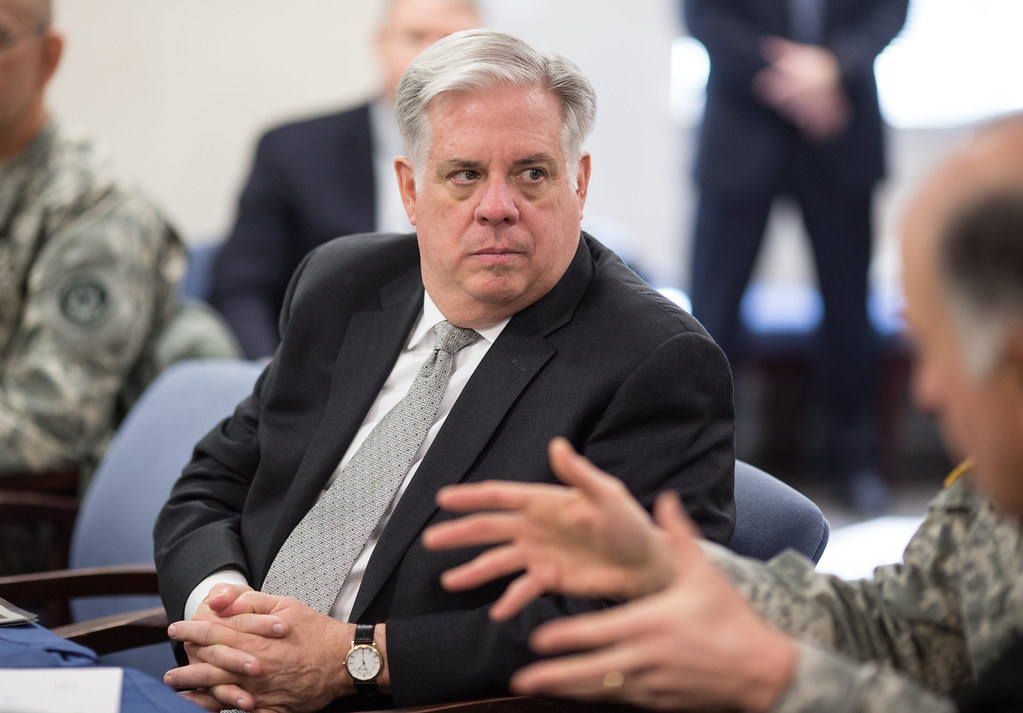
Former Maryland governor Larry Hogan has proclaimed his intention to run for the United States Senate, presenting his campaign as a bipartisan initiative that seeks to unite the state’s interests above party distinctions and tackle the contentious political issues that plague the country. Hogan, a Republican candidate who has openly criticized Donald Trump, seeks to fill the vacancy created by Democratic Senator Ben Cardin’s retirement. Cardin’s retirement signifies the conclusion of an illustrious Senate career, which commenced with his election to the House of Representatives and the Maryland state legislature. In a state where a Republican has not been elected to the Senate in many years and where a large field of Democrats is already competing for Cardin’s seat, Hogan’s declaration is significant.
Hogan’s political legacy encompasses his father, Larry Hogan Sr., whose historic endorsement of President Nixon’s impeachment demonstrated a preference for principle over party politics. In his campaign, Hogan Jr. accentuates this legacy, implying that bipartisan leadership of this caliber is scarce in contemporary Washington, D.C. Throughout his two terms as governor, Hogan took great delight in achieving tax cuts, balancing the budget, and generating a record surplus while navigating the state through significant challenges through bipartisanship.
The former governor offers a critique of the prevailing political discourse in Washington, contending that it is preoccupied with partisan ambitions rather than the genuine interest of serving the American people. Following his support for Nikki Haley’s candidacy for the Republican presidential nomination in 2024 and his departure from the leadership of the No Labels movement, which promotes centrist political solutions, Hogan has decided to run for senate. Despite having previously contemplated a candidacy for the Republican presidential nomination and even examined the possibility of a third-party campaign, Hogan ultimately made the decision to concentrate his political aspirations on the Senate.
Hogan has received endorsement from Senator Steve Daines, chairman of the National Republican Senatorial Committee, who cites the candidate’s prominence and effective governance in Maryland. Despite this, Hogan’s proposal has been met with opposition, with some critics considering it a vain endeavor. Although there are still obstacles to overcome, Hogan’s campaign signifies a momentous occasion in the political sphere of Maryland, as it pledges to prioritize bipartisanship and efficient governance.