
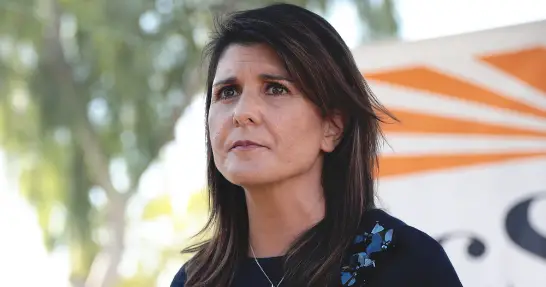
Former U.N. Ambassador and Republican presidential hopeful Nikki Haley faced backlash after proposing mandatory verification for social media users, citing national security concerns. Haley outlined her stance during a Fox News appearance, where she called for transparency in social media algorithms and mandatory user verification to combat foreign interference and improve civility online.
Critics, including some of her Republican primary opponents, quickly condemned Haley’s proposal as unconstitutional and overreaching. Florida Governor Ron DeSantis and entrepreneur Vivek Ramaswamy were among those who criticized Haley, referencing the historical precedent of anonymous writing by the Founding Fathers in the Federalist Papers. DeSantis labeled Haley’s proposal as dangerous and vowed that it would be “dead on arrival” in his administration.
Ramaswamy also disparaged Haley’s comments, invoking the Federalist Papers and criticizing her for attempting to suppress anonymous speech. Conservative activist Charlie Kirk and digital strategist Greg Price joined the chorus of critics, with Kirk emphasizing the importance of anonymous speech as a fundamental aspect of free speech.
Journalist Glenn Greenwald echoed these sentiments, calling Haley’s proposal “blatantly unconstitutional” and labeling her as authoritarian. Dan Caldwell, Vice President of the Center for Renewing America, highlighted the role of anonymous speech in American free speech traditions.
The proposal also sparked concerns about its potential impact on conservatives’ freedom of expression, with fears that it could lead to job losses for expressing opinions. Christina Pushaw, Rapid Response Director for DeSantis, and Noah Jennings from the pro-DeSantis superPAC Never Back Down, also joined the criticism.
In response to the mounting criticism, Haley’s campaign defended her stance, asserting the need for social media companies to verify users more effectively to counteract the influence of foreign bots from countries like China, Iran, and Russia.
The controversy over Haley’s proposal underscores the complex debate surrounding social media, free speech, and national security, highlighting the challenges of balancing these competing interests in the digital age.