
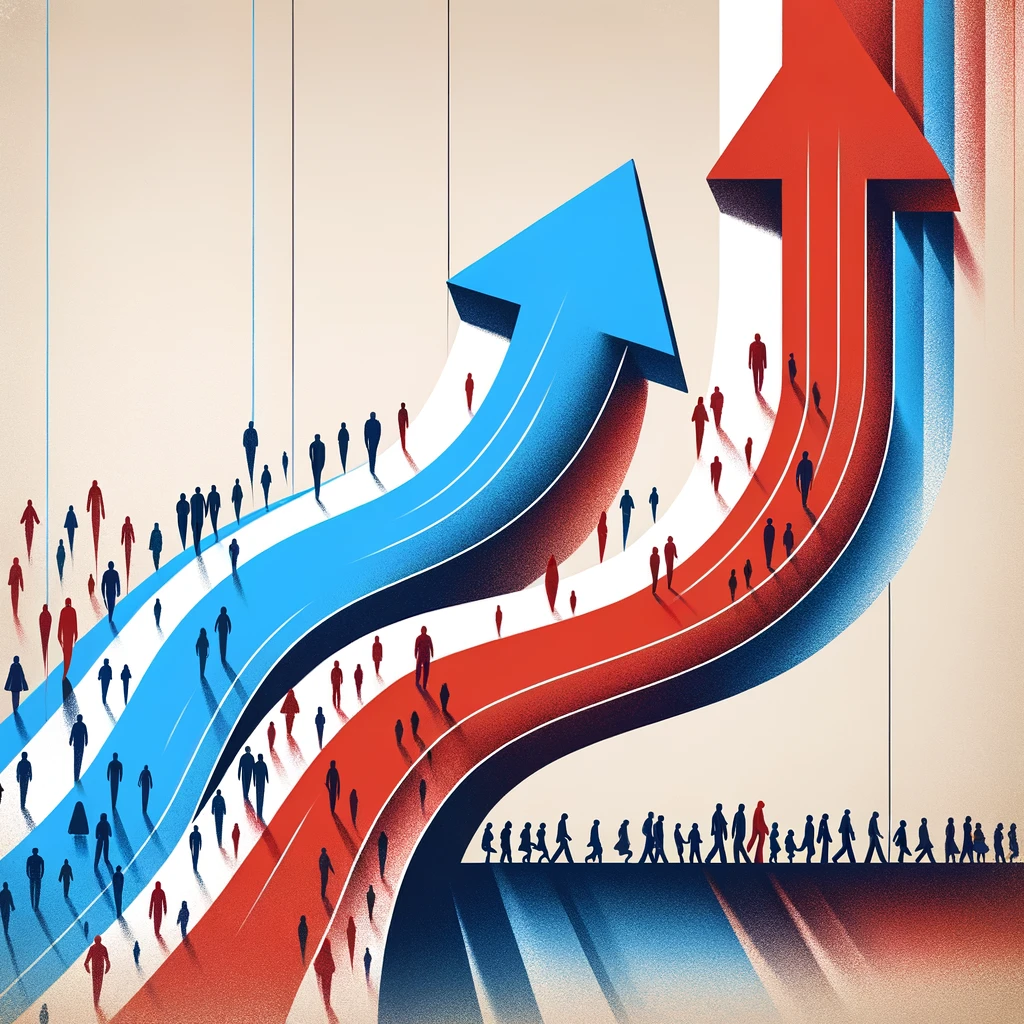
Recent polling data reveals a significant shift in the political landscape, with the Democratic Party’s long-standing advantage among Black and Hispanic voters diminishing to historic lows. According to a Gallup survey, the allegiance of Black adults to the Democratic Party has seen a notable decline. Last year, 66% of Black adults aligned themselves with the Democrats or leaned towards the party, a stark contrast to the 77% allegiance observed in 2020. This reduction to a 47-percentage-point gap marks the narrowest margin in at least 25 years.
Hispanic voters, too, are part of this changing dynamic, with only 47% now identifying as Democrats, a decrease from 57% in 2021. The gap between those identifying as Democrats and Republicans among Hispanic voters has narrowed to just 12 points, down from a 31-point difference previously. This shift points towards a broader political realignment that could reshape party affiliations and strategies moving forward.
Conversely, the Republican Party has solidified its position among white voters, maintaining a double-digit lead since 2013. In the latest data, 54% of white voters identify as Republicans or GOP leaners, compared to 38% who align with the Democrats. Male voters also predominantly favor the GOP, with 52% identifying as Republicans or leaners, while women show a smaller preference for the Democrats.
Overall, the landscape shows a reversal from 2020, with 45% of U.S. adults identifying as Republicans compared to 43% as Democrats. This shift underscores the evolving political preferences across demographic groups, challenging the traditional stronghold Democrats have held among minority voters.
Democrats continue to enjoy significant advantages among specific groups, including adults with postgraduate degrees, city dwellers, and those not affiliated with any religion. Republicans, on the other hand, have substantial leads among weekly churchgoers, rural voters, Protestant or non-Catholic Christians, and residents of the Southern United States.
This polling data, collected throughout 2023 from over 12,000 adults nationwide, indicates a complex and shifting political reality. As both parties navigate these changes, the strategies and messages to engage these crucial voter groups will undoubtedly evolve, reflecting the diverse and dynamic nature of the American electorate.