
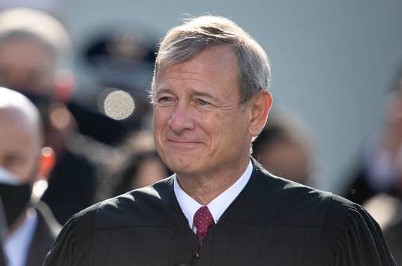
Chief Justice John Roberts, in his decision published on Friday, cited former House Speaker Nancy Pelosi to explain why President Biden’s student loan forgiveness plan was deemed illegal by the Supreme Court. Roberts found Pelosi’s statement that the president lacked the authority to forgive federal student loan debt to be persuasive.
Roberts quoted Pelosi’s press conference from July 28, 2021, where she stated, “People think that the President of the United States has the capacity for debt forgiveness. Not at all. The delay is up to him. In other words, he can take his time. However, he does not possess such authority. That calls for a legislative resolution.”
Roberts also referenced Justice Amy Coney Barrett’s concurring opinion, pointing out that the dissent offered little to rebut their conclusion. He highlighted that indicators from previous major cases with similar questions were present in this case.
As the Supreme Court prepares to rule on various high-profile issues in the coming months, Roberts’ perspective holds relevance.
In a separate case involving a Christian web designer’s refusal to create websites for same-sex weddings, Justice Neil Gorsuch criticized Justice Sonia Sotomayor’s dissenting opinion. In the 6-3 ruling, the Supreme Court concluded that Lorie Smith, the web designer, was not compelled to create websites for homosexual marriages based on her free speech rights and religious convictions, despite Colorado’s anti-discrimination law.
Gorsuch expressed difficulty in reconciling Sotomayor’s dissent with the actual case, stating, “It’s difficult to read the dissent and conclude we are looking at the same case.” He argued that Sotomayor reimagined the facts and failed to address the central question of whether the state can force someone providing expressive services to abandon their conscience and promote a message they disagree with.
Gorsuch further critiqued the dissent, pointing out inconsistencies in its arguments. He highlighted a passage that seemed to contradict itself, where the dissent emphasized that a Colorado business cannot refuse services based on a customer’s protected status but also claimed that a company selling creative services has the right to decide what messages to include or exclude. Gorsuch questioned the purpose of the debate if such a contradiction exists.
Gorsuch also noted that the dissent relied heavily on hypothetical scenarios involving photographers, stationers, and others providing expressive services covered by the First Amendment.
The ruling overturned a lower court decision that had gone against Smith, who argued that the statute violated her First Amendment rights by compelling her to promote statements conflicting with her religious beliefs.
The majority opinion stated that under Colorado’s logic, the government could compel anyone who speaks for pay on a particular topic to accept all commissions on that same topic, regardless of the message, as long as it may impact a customer’s protected trait.
Justices Elena Kagan and Ketanji Brown Jackson joined Sotomayor in dissent, asserting that the ruling granted a new license to discriminate and relegated gays and lesbians to a second-class status symbolically.
Sotomayor argued that the majority’s view upheld an ugly lesson of “what’s mine is mine, and what’s yours is yours,” whereas public accommodations rules teach a different lesson based on history. She emphasized that a democratic and free society should not allow social castes to exist.
The case garnered attention due to the clash between the First Amendment’s protection of free expression and its prohibition of discrimination based on sexual orientation or gender identity.