
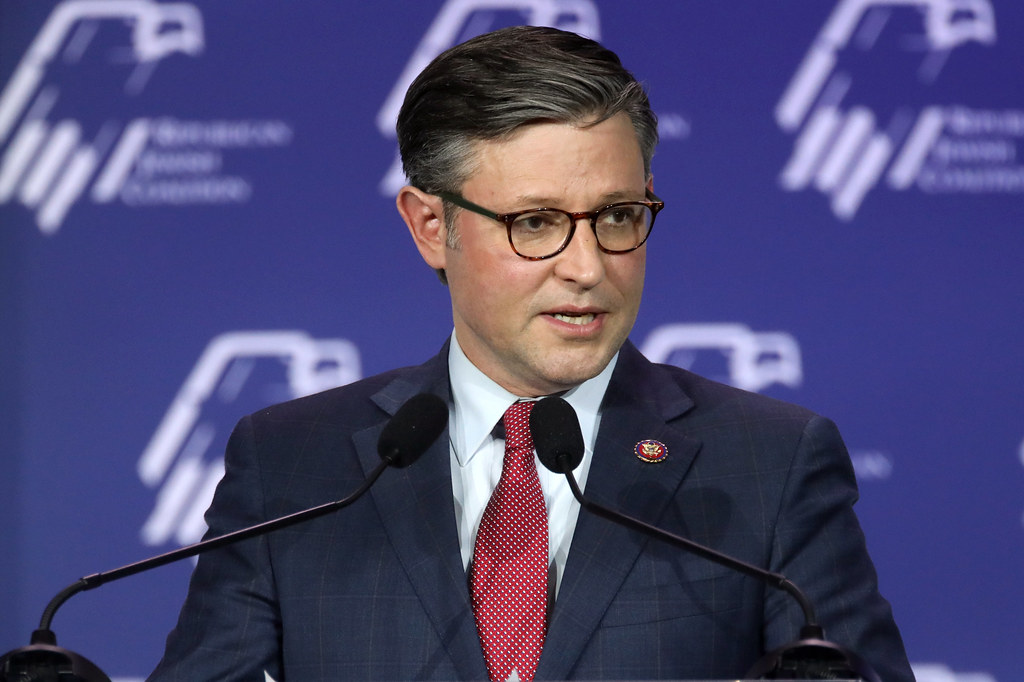
House Speaker Mike Johnson, a Republican from Louisiana, has vocally criticized Democratic lawmakers following reports that they are considering legislative action in response to the Supreme Court’s unanimous decision to maintain former President Donald Trump’s eligibility for the 2024 ballot in Colorado. The Supreme Court’s ruling clarified that states do not have the authority under the Constitution to enforce Section 3 of the Fourteenth Amendment concerning federal offices, including the presidency, emphasizing that this responsibility lies with Congress.
The controversy began when Rep. Jamie Raskin, a Democrat from Maryland and a former member of the January 6 select committee, indicated he was in the process of drafting federal legislation aimed at preventing Trump from appearing on the ballot. This move by Raskin and potentially other Democrats has sparked a strong reaction from Speaker Johnson, whose spokesperson urged Democrats to “get a grip,” asserting that the decision of who becomes the next president should be left to the American people, not the courts or Congress.
Raskin’s proposed legislation, which he initially introduced in 2022 alongside Rep. Debbie Wasserman Schultz from Florida, seeks to empower the Justice Department to challenge the eligibility of candidates under the Fourteenth Amendment. Raskin plans to revise this bill in light of the Supreme Court’s recent decision and pair it with a resolution that would officially declare January 6 as an “insurrection,” thereby implicating those involved.
While Trump faces several federal charges related to the 2020 election, he has not been charged with insurrection. The Supreme Court’s ruling, which found that states lack the authority to enforce Section 3 of the Fourteenth Amendment, has been met with mixed reactions. Justices Sonia Sotomayor, Elena Kagan, and Ketanji Brown Jackson, in a separate opinion, criticized the majority for asserting that only Congress has the enforcement authority, suggesting that this interpretation unnecessarily limits other potential means of federal enforcement.
This development has ignited a debate over the balance of power between state and federal authorities in determining the eligibility of presidential candidates, especially those accused of engaging in insurrection. As discussions continue, the actions of Democratic lawmakers in response to the Supreme Court’s ruling could have significant implications for the upcoming presidential election and the broader political landscape.