
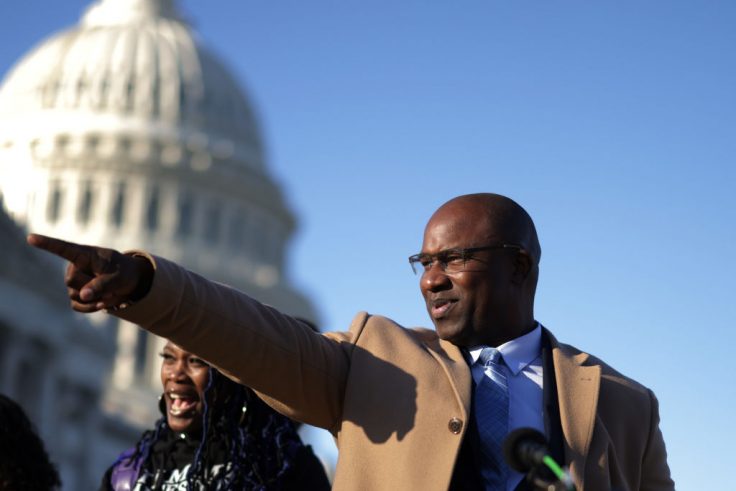
Representative Jamaal Bowman of New York has put forward a bold proposal, advocating for a $14 trillion federal reparations program to address the legacy of slavery in the United States. As a member of the “Squad,” Bowman emphasizes the government’s moral and legal obligation to redress the historical injustices of slavery.
In his proposition, Bowman draws parallels between the government’s expansive financial response to the COVID-19 pandemic and the space race, suggesting that similar measures could be adopted to fund the reparations without raising taxes. “The government has demonstrated its capacity to mobilize significant resources in times of need. This should be no different,” Bowman stated.
His plan is outlined in H.R. 414, a bill introduced in 2023, which asserts that the U.S. bears a responsibility to provide reparations for the enslavement of Africans and the enduring impact on Black Americans. This measure could potentially bridge the racial wealth gap and address disparities in housing, education, and mass incarceration.
Bowman points to the staggering figure of over 222 trillion hours of forced labor from 1619 to the end of slavery in 1865, valued today at approximately $97 trillion, as a basis for the reparations figure. “Our economy owes its existence to the contributions of enslaved individuals. It’s time we acknowledge and compensate for that,” Bowman explained.
The reparations proposal, which has not yet gained support in the Senate, could be distributed over decades, breaking it down into more manageable financial segments. “The $14 trillion need not be disbursed in one go. It could be a phased approach, with the amount divided over years, ensuring a sustained commitment to this cause,” Bowman added.
This proposal comes amidst various efforts to address reparations on both federal and state levels, with states like New York exploring methods to provide reparations to descendants of slaves. Governor Kathy Hochul recently signed a bill establishing a commission to study slavery in New York and recommend forms of reparations.
As the conversation on reparations gains momentum, Bowman’s plan offers a creative and comprehensive approach to addressing one of America’s longest-standing issues.