
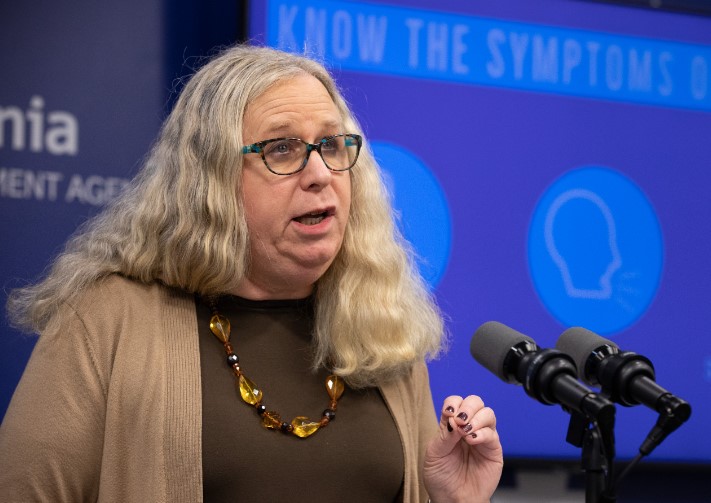
Assistant Secretary Rachel Levine of the Department of Health and Human Services (HHS) sparked a whirlwind of controversy this week with a statement that set tongues wagging. During an interview on ABC’s “Nightline” series, “Identity Denied: Trans in America,” Levine, a transgender woman, delved into the sensitive topic of gender-affirming care for transgender youth.
Her comment about the possibility of experiencing “the wrong puberty” raised eyebrows and drew both support and criticism. Levine defended the treatment options as evidence-based, citing the difficulties of adolescence and puberty. She posed the question, “What if you’re going through the wrong puberty? What if you feel internally that you are female, but your body is undergoing male puberty?”
The remark ignited a firestorm of diverse reactions. While some applauded Levine for addressing the challenges faced by transgender youth, others vehemently disagreed with the notion of “wrong puberty.” Among those who spoke out was Daily Wire Editor Emeritus Ben Shapiro, who condemned what he perceived as granting “mentally ill” individuals significant influence to propagate what he termed “insane things.”
Florida Governor and Republican presidential candidate Ron DeSantis urged Americans to “fight back” against what he labeled “woke bureaucrats” who he believed were pushing misleading narratives. He vehemently rejected the concept of going through “the wrong puberty” and accused these officials of undermining the country and misleading children.
Senator Tom Cotton also joined the chorus of criticism, accusing Levine of advocating unsafe procedures unsupported by scientific evidence, particularly concerning children.
Adding a touch of satire to the debate, Daily Wire podcast host Matt Walsh took to Twitter, humorously extending the idea of having the “wrong” body parts to the realm of absurdity. He playfully questioned whether one could have the “wrong” liver, kneecap, eye color, or even DNA, highlighting the complexity of such assertions.
The discourse surrounding Levine’s remarks highlights the ongoing complexities and divergent perspectives on gender identity and the care of transgender youth. It also underscores the need for open dialogue and understanding as society grapples with these complex issues.