
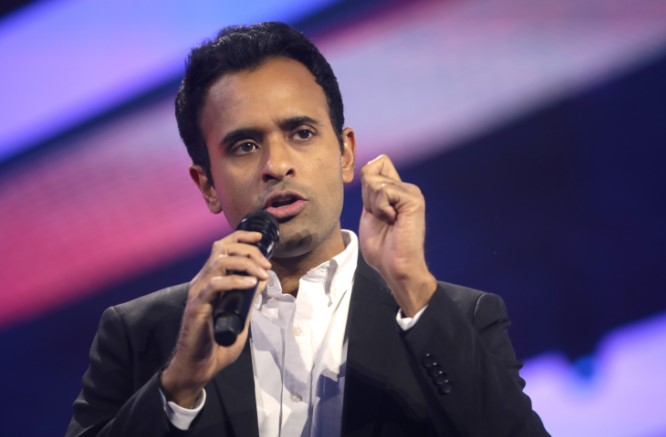
In a recent appearance on MSNBC, Vivek Ramaswamy, a potential Republican presidential candidate for 2024, challenged host Andrea Mitchell’s assertion that climate change has led to the deaths of two million people over the past five decades. Ramaswamy countered her claim by presenting evidence that technology driven by fossil fuels has significantly reduced climate-related deaths by 98%.
Mitchell initially brought up Ramaswamy’s past statement about climate change being a “hoax” and questioned his position on climate change. She referenced a U.N. agency’s report that linked extreme weather events exacerbated by climate change to the deaths of two million individuals between 1970 and 2021. She then asked Ramaswamy if he had evidence to support the claim that more than two million people had died due to transitioning to clean energy.
Ramaswamy contested her point by highlighting the role of fossil fuels in enhancing survival rates during climate-related natural disasters. He presented data indicating that climate disaster-related deaths have decreased by 98% over the last century. He noted that while 100 people died due to such events in 1920, only two die today. He attributed this improvement to increased access to fossil fuels and the technology powered by them.
He continued by emphasizing that eight times as many people die from cold temperatures compared to warm ones. Ramaswamy stated that the solution to temperature-related deaths lies in ensuring ample access to fossil fuels.
When Mitchell mentioned the concerns of Floridians about the severity of Hurricane Idalia, Ramaswamy challenged her anecdotal evidence as insufficient for making broader claims about climate change. He asserted that relying on isolated weather events to support theories of global climate change is akin to disregarding data and relying on personal opinions. Ramaswamy highlighted the need to base arguments on factual evidence rather than isolated anecdotes.
Mitchell attempted to counter Ramaswamy’s argument by citing conversations with professors, academics, and industry experts. However, Ramaswamy interjected once again, pointing out that her citation of a single person’s opinion was analogous to the type of anecdotal evidence he had just critiqued. He emphasized that focusing on verifiable data is crucial to engaging in a meaningful discussion about climate change.
The exchange between Ramaswamy and Mitchell underscores the ongoing debate surrounding climate change, highlighting the importance of relying on comprehensive data and evidence when discussing complex issues with significant implications.