
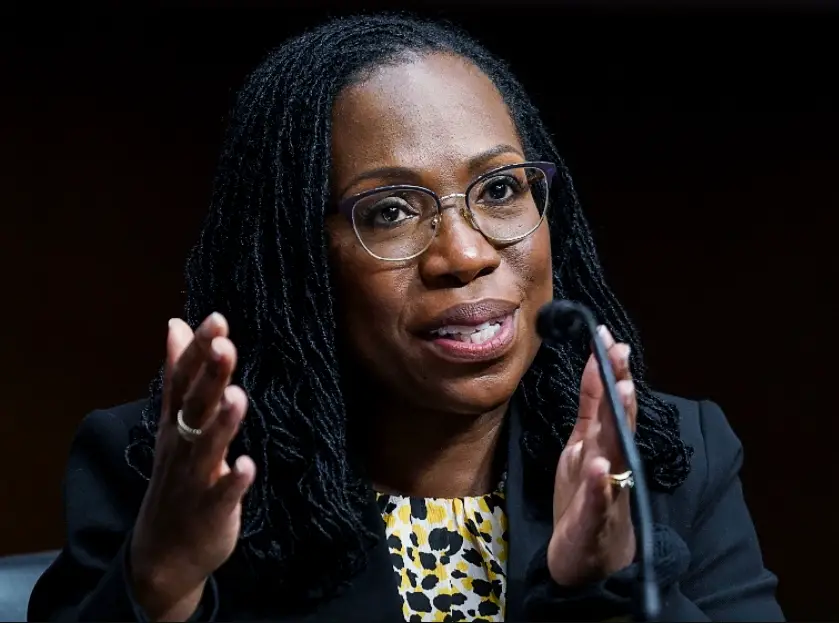
In a thought-provoking op-ed published in the Wall Street Journal, attorney Ted Frank challenged a dissenting claim made by Supreme Court Justice Ketanji Brown Jackson regarding the impact of diversity on Black newborns. Frank argued that Justice Jackson’s assertion was “mathematically absurd” and lacked credibility.
In her dissenting opinion, Justice Jackson argued that diversity in the medical field is crucial for marginalized communities, as it can save lives. She contended that research showed Black physicians are more adept at assessing pain tolerance and providing appropriate treatment to Black patients. Furthermore, she claimed that having a Black physician significantly increased the chances of survival for high-risk Black newborns.
Ted Frank swiftly countered this argument in his op-ed, pointing out the implausibility of Justice Jackson’s claims. He illustrated that even if 40% of Black newborns faced mortality, resulting in thousands of deaths weekly, the survival rate would still be 60%, which cannot be mathematically doubled. Frank emphasized that the actual survival rate for newborns is over 99%, making Justice Jackson’s assertion highly improbable.
Frank questioned how such an “innumerate mistake” could be made by a Supreme Court Justice. He noted that Justice Jackson cited a 2020 study to support her claim, but upon examination, it became evident that the study did not substantiate her argument. The study, which analyzed mortality rates in Florida newborns from 1992 to 2015, indicated a minor improvement in survival rates for Black newborns with Black pediatricians, but not statistically significant changes for Black obstetricians.
The Supreme Court’s recent decision to reject the use of race as a factor in college admissions was also mentioned. Chief Justice John Roberts, in the majority opinion, highlighted the need for benefits to be linked to a student’s resilience and determination in overcoming racial discrimination.
Frank criticized the flawed nature of the study referenced in Justice Jackson’s dissent. He concluded by cautioning against blindly accepting mathematically unsound claims, especially when they stem from a mischaracterization of a flawed study by an interested party. Instead, he urged a mindful approach, suggesting that we should be cautious about the path we tread.