
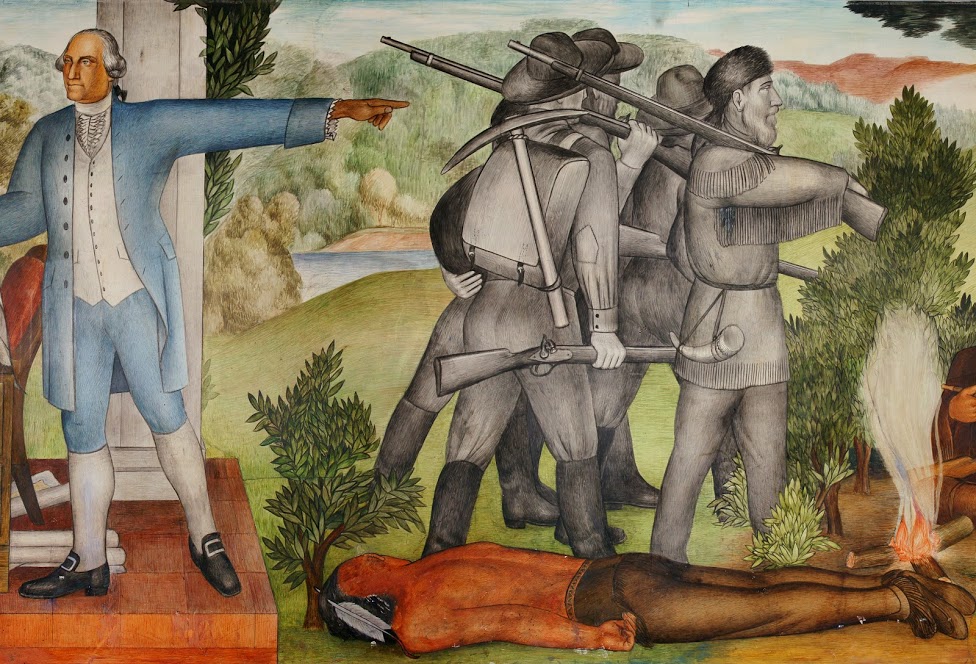
A school in San Francisco (Where else?) is considering their options in getting rid of two murals of George Washington. They are now considering three options.
The first option is to cover them with curtains at a cost of 300k, painting over them at a cost of 600k or paneling over them at a cost of a whopping 875k. The school says the murals are triggering black students and native Americans. If I were a parent in that school district, I would remember this every time the board asked for a raise in revenue via the school tax.
“Two of the thirteen panels in the mural series have come under fire since the 1960’s for their controversial depictions of African-Americans and Native Americans,” the Richmond District Blog writes.
In one mural, entitled “Mount Vernon”, George Washington appears to be in conversation with another Caucasian man who gestures towards a seated African-American man holding corn, presumably a slave. In other parts of the mural, African-Americans are engaged in acts of manual labor like hauling large bales of hay and picking cotton in the fields, while Caucasian men are also laboring at other tasks with tools. Washington’s servant, who is pictured holding his horse, is also African-American. The mural is a clear depiction of slavery in the United States, and of George Washington as a slave owner.
The second panel, entitled “Westward Vision,” depicts Benjamin Franklin and other founding fathers looking at George Washington as he points off in the distance, while he points with his other hand to a map. On the right side of the mural, as if carrying out Washington’s call for westward expansion, frontiersmen, depicted in greyscale unlike other figures in the mural, stand over the dead body of a Native American man, signifying the genocide of Native American life and culture.
In the bottom right of the “Westward Vision” panel, a frontiersman and Native American chief sit at a campfire smoking a peace pipe. On the ground at the chief’s feet is a tomahawk, symbolizing the disarming of Native tribes. Directly above the Chief’s headdress is a broken tree limb representing broken treaties made by the U.S. government with Native Americans, and broken promises made by settlers.